Global Market -
Import Replacement & Export Opportunity
A Third Dimension in Australia’s Sustainable Energy Mix.
Energy is currently viewed in Australia in just two dimensions – fossil fuels or renewables.
Utilising stranded carbon assets, AFE is positioned to deliver the third future-focussed dimension to Australia’s energy mix.
Following the closure of domestic production capacity, Australia now imports 91% of its liquid energy requirements, increasing exposure to global price shocks and supply disruption.
At the same time, large volumes of carbon-based materials continue to be generated, are largely underutilised, and simply dumped, stockpiled or sent to landfill.
These are not two separate challenges.
They are two sides of the same structural disconnect. Australia discards carbon that can be commercially recovered yet imports carbon-intensive fuels that could be produced domestically.
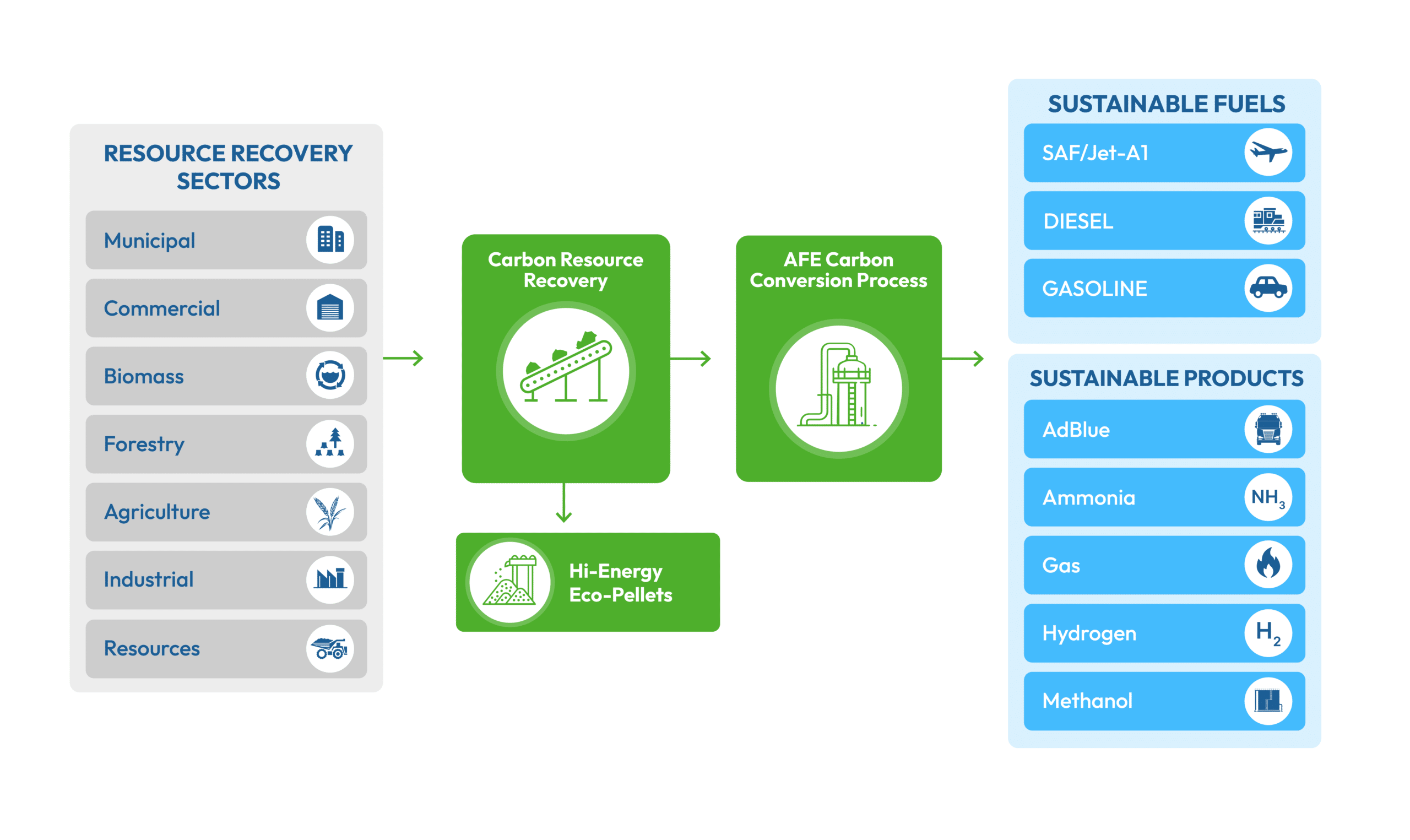
A circular economic model doesn’t just address both issues – it reframes them as a single integrated opportunity, delivering a third dimension to Australia’s renewable energy mix, supporting our transition to a sustainably fuelled future.
AFE exists to address this structural imbalance and assist in building a resilient sustainable energy future.
The AFE Model
Rather than a linear “extract-refine-consume” model MeOH operates within a circular carbon framework – where waste becomes feedstock, and output becomes value.
Global Market
Aviation Fuel
300
m tonnes*
Diesel
1.4
b tonnes**
Gasoline
1.2
b tonnes***
Gas
4.23
t cubic meters****
AdBlue
16.7
m tonnes*****
Ammonia
194
m tonnes#
Hydrogen
100
m tonnes##
Methanol
125
n tonnes###
Source: *IATA; ** Market Growth Reports; *** Statista; **** Worldmeter; *****Market Reports World #ACS; ##IEA; ###Ken Research
Cardboard & Paper - National Recycling & Recovery Data (Australia, 2024–25)
(Source: DCCEE&W)
Total Generation: ~4.9 Mt (about 179 kg per capita), of which 75% was packaging.
Recycled Amount: ~2.4 Mt recycled.
Energy Recovery: ~77 kt
Export for Reprocessing: ~42%
Landfilled: ~2.4 Mt
Overall Recovery Rate: ~55%
Visy is Australia’s largest recycling processor. It collects paper and cardboard from over 4 million Australian homes and more than 7,000 commercial businesses. After sorting at Material Recovery Facilities (MRFs), recovered materials are sent to Visy’s paper mills, where they are converted into 100% recyclable corrugated cardboard boxes and packaging.
Established recycling industries demonstrate the commercial viability of recovering value from previously discarded materials.
Commercial Partners
Protecting the Environment | Preserving Water Supplies | Energy from Waste
Team
Proven Technologies | 200+ years combined Team sector experience